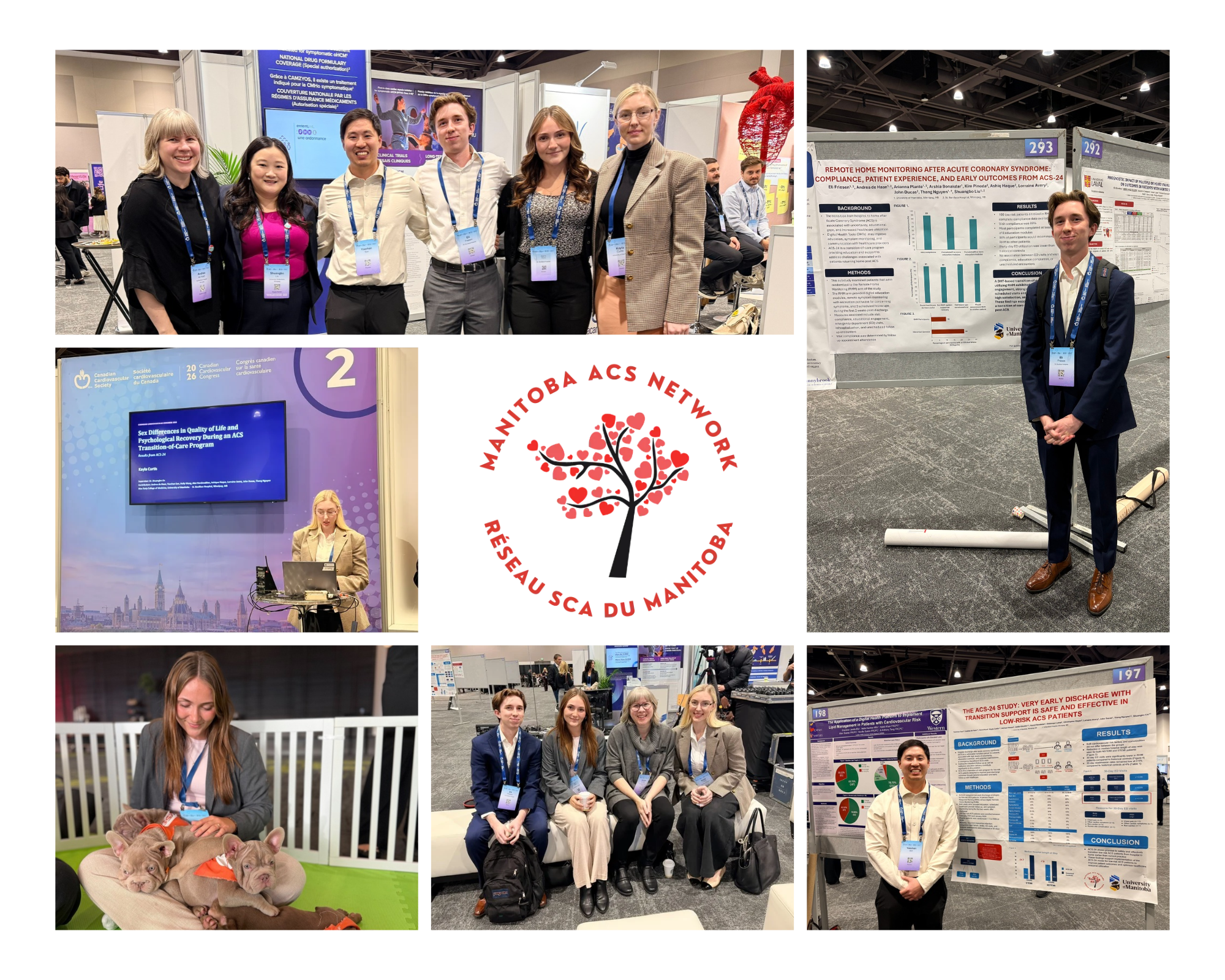
The MB ACS Network was delighted to bring a group of students and trainees to this year’s Canadian Cardiovascular Congress (CCC) in Ottawa. For many of them, it was a first chance to experience a national scientific meeting, where they presented their work, attended sessions led by leaders in the field, and connected with peers and mentors from across the country. A few of the attendees also wrote short reflections on their experience, which we’re pleased to share below.
Andrea de Haan’s Experience
I attended a great session on Patient Partnership in Cardiovascular Research, which reinforced the importance of meaningfully engaging patient partners throughout the research process. Two key takeaways stood out to me:
1. Patient partnership must go beyond validation
Patient partners should be engaged as active contributors to research, not simply asked to validate decisions that have already been made. Meaningful partnerships involve patient partners throughout all aspects of the research process, from shaping research questions and study design, to interpreting findings and sharing results. Their value lies not in agreeing with researchers, but in bringing perspectives that can challenge assumptions and lead to better research.
2. Patient partners can influence research at every stage
Patient partners bring valuable perspectives and insights that can shape research in four key areas:
· Priorities: Helping identify which questions are worth asking and which outcomes matter most in daily life.
· Study Design: Informing feasible protocols, realistic study burden, and approaches to recruitment that reach beyond the usual participant groups.
· Interpretation: Helping determine whether statistically significant findings are meaningful to patients and identifying what the results may overlook or fail to capture.
· Knowledge Translation: Co-creating plain-language outputs, identifying effective community channels, and shaping messages that resonate with people and support action.
Yaechan Son’s Experience
2 reflections I have from my experience at the CCC:
Overall, I had a very positive experience at CCC 2026. It was the first conference that I have ever attended, and I feel that I have gained insight into how valuable these can be for both learning and networking opportunities. I felt that I had some decision fatigue as it was hard to pick and choose between different sessions as there was such a wide variety of interesting topics available to learn about. I was grateful that there were sessions relevant to practice as a family physician. It was helpful to learn more about uACR and its connection to cardiovascular risk. Being able to explore Ottawa was also a big bonus for me.
It was also my first time presenting a poster at a conference. I am grateful for the opportunity that was given to me to present the ACS24 study findings. Being able to interact with other presenters was a valuable experience. I was particularly interested in a project that utilized a digital health tool to optimize lipid lowering therapy in patients who were not meeting their LDL goal. I felt that something like this would be very helpful if implemented in a busy family medicine clinic. I definitely left the conference with many new topics to read about and ideas to incorporate into my own future practice.
Arianna Plante’s Experience
Over the course of the meeting, I went to many talks and learned a great deal about a range of timely topics, including sex differences in cardiovascular health, the effects of cannabis on cardiovascular outcomes, and new lipid-lowering medications. It was inspiring to hear from leaders in the field and to see how quickly the science is evolving.
Two interesting things I learned at CCC 2026:
Cannabis use is associated with increased cardiovascular risk in two distinct ways. Over the long term, it raises the risk of chronic coronary artery disease. In the short term, it is linked to acute cardiovascular events, with risk concentrated within the first 60 minutes after use.
Small nucleic acid therapies such as siRNAs (plozasiran) and antisense oligonucleotides (olezarsen) work by silencing the production of proteins in the liver that impair triglyceride clearance. This leads to large reductions in triglycerides, which is especially important in familial chylomicronemia syndrome and severe hypertriglyceridemia, where very high levels greatly increase the risk of acute pancreatitis. Each drug molecule can be reused to silence many transcripts, which allows for infrequent dosing.